




From waste to strategic resource
Europe has set a clear course: climate neutrality, energy independence and the transition to a truly circular economy. The strategies are defined, the targets quantified and the regulatory framework in place.
However, a critical gap remains between political ambition and the effective implementation of these sectors in the market.
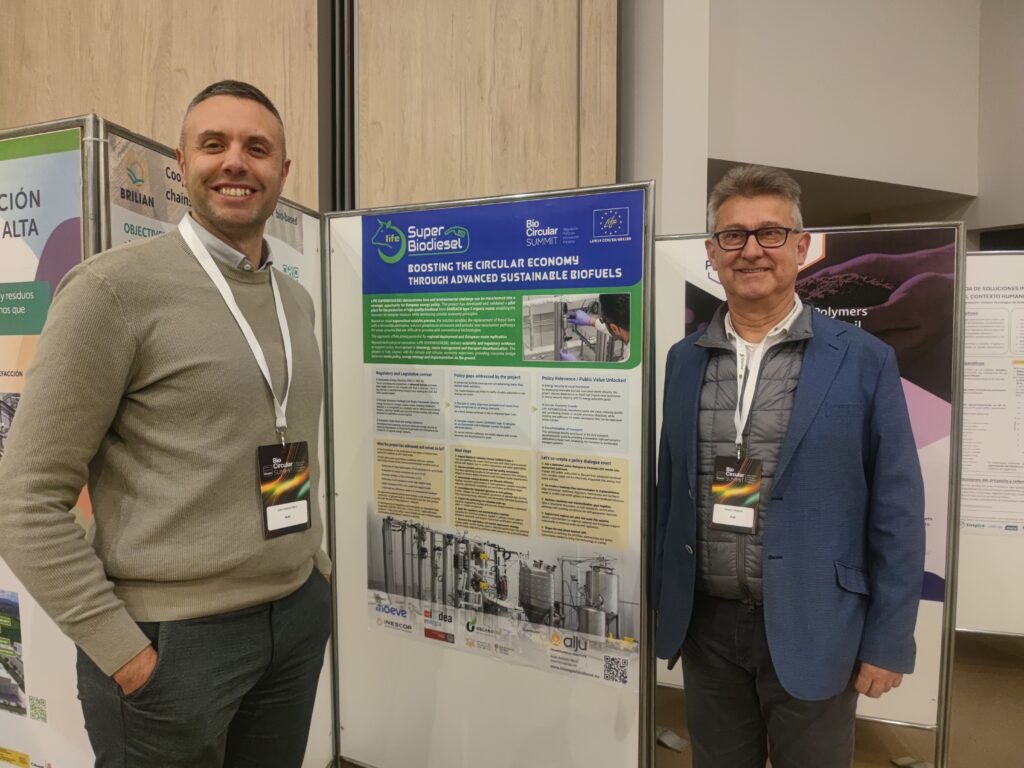
At the Bio-Circular SUMMIT 2026, the LIFE Superbiodiesel project sought to bridge that gap through its participation in the networking area with the technical poster presented. Because the question is no longer whether we need advanced biofuels.
The question is: how do we ensure that these next-generation biodiesels can reach the market?
The starting point: waste not valued as a resource
In Europe, SANDACH Category 3 organic waste continues to be managed as an environmental and budgetary burden for public authorities. Yet, from a technological perspective, it contains significant energy value.
LIFE Superbiodiesel has demonstrated that this waste can be transformed into high-quality advanced biodiesel, with technical guarantees, process stability and operational viability. The validation of a functional pilot plant confirms that its recovery can be integrated into circular economy models.
The challenge is to inform the regulatory and legislative framework with scientific evidence
In a European context that sets ambitious targets for renewable energy, waste recovery and the decarbonisation of transport, LIFE Superbiodiesel has demonstrated, under real-world conditions, the production of advanced biodiesel from SANDACH-3, optimising the process to ensure quality, efficiency and circular integration via the glycerine-to-fuel pathway. Furthermore, it has assessed its sustainability and industrial robustness, consolidating the technical viability of the model.
These advances are essential to meeting transport decarbonisation targets and fostering a genuine circular economy, where waste is transformed into high-value resources. However, despite the results, the key lies in the effective integration of this technology. To this end, the regulatory framework, standards and certification systems must evolve in tandem with technological innovation. It is not a question of moving forward separately, but of doing so in a coordinated manner.
In this context, LIFE Superbiodiesel does not merely provide technological innovation. It provides validated evidence to underpin policy decisions that can transform the biofuels industry. This evidence strengthens local energy security, promotes an effective circular economy and contributes to the decarbonisation of transport, aligning with the RED objectives.
The next step: from demonstration to deployment
With the demonstration phase successfully completed, LIFE Superbiodiesel is now focusing on expanding the validation of raw materials, improving the industrial robustness of the process, demonstrating catalytic durability, preparing for scale-up, and developing a regulatory and standardisation roadmap to facilitate its integration into the market.
But no scaling-up will be possible without regulatory support and institutional alignment.
That is why, at the BioCircular SUMMIT 2026, the project did not merely present technical results. It issued an invitation.
An invitation to stakeholders such as policymakers, industry and the market to co-create a roadmap from demonstration to regional implementation, jointly address regulatory gaps, drive regional pilot projects and define a new strategic phase beyond the LIFE programme.
The future is now, and LIFE Superbiodiesel is ready to lead the way.
Now is the time to transform waste into renewable energy and a strategic resource that will not only boost our economy but also drive the transition towards a more sustainable Europe.
To this end, through the contacts established, the LIFE Superbiodiesel project aims to bring together various initiatives pursuing the same objective (the implementation of biofuels) to organise a joint event with policy-makers.
Please do not hesitate to contact us if you would like to join this initiative.
Comments are closed.